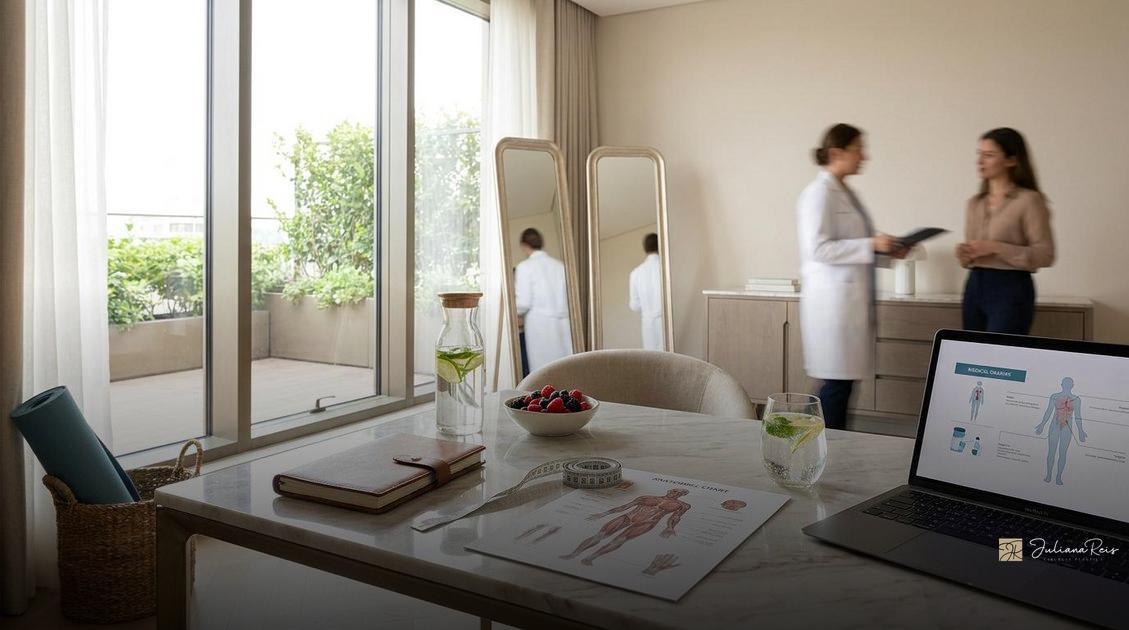
Do you feel constant pain and heaviness in your legs that no diet can resolve? Or are you looking to improve your body contour after massive weight loss, but fear aesthetic promises that do not match reality? The decision to undergo tummy and breast surgery is one of the most profound steps you can take on your journey to reclaiming your quality of life. In my office, the first thing I do is actively listen to your story. I understand the physical and emotional toll that excess skin or disproportionate fat accumulation can take on a person. Whether you are seeking reconstructive surgeries or a comprehensive approach to a chronic condition, my goal is to map out the best plan for your case, ensuring that your expectations are strictly aligned with what modern plastic surgery can safely deliver.
My approach goes far beyond the operating room. Aesthetic success and smooth recovery are intimately tied to your overall well-being. Therefore, I use tools from lifestyle medicine in my practice as a plastic surgeon to prepare your body before we even think about the scalpel. By treating the patient as a whole rather than just addressing an isolated aesthetic complaint, we can achieve outcomes that are not only beautiful but also sustainable. Let us explore how advanced surgical techniques, combined with an unyielding commitment to your health, can transform your reality.
What to expect from reconstructive breast and abdomen surgery?
When patients come to my office seeking reconstructive breast and abdomen surgery, they are often carrying the physical evidence of a long and challenging journey. Post-weight loss body contouring is a highly specialized field within plastic surgery that requires a deep understanding of tissue dynamics. Massive weight loss, whether achieved through bariatric surgery or profound lifestyle changes, often leaves behind significant amounts of inelastic skin. This excess tissue can cause physical discomfort, hygiene issues, and prevent individuals from fully enjoying their new, healthier bodies.
Abdominoplasty, commonly known as tummy surgery, aims to remove this excess skin, repair weakened abdominal muscles, and restore a smoother, firmer profile. It is not merely a cosmetic enhancement; it is a reconstructive necessity for many. Similarly, breast surgery in this context—whether it involves a mastopexy (breast lift), reduction, or augmentation with implants—focuses on restoring the youthful anatomical position and volume that is lost when significant adipose tissue is depleted.
I am extremely transparent about the pros, cons, and real limits of surgery. It is vital to understand that reconstructive surgeries involve extensive incisions, which translates to permanent scars. However, with precise surgical techniques and proper post-operative care, these scars fade and are generally well-hidden beneath undergarments. My commitment as a USP-trained plastic surgeon is to prioritize your safety and deliver realistic plastic surgery expectations. We do not chase unattainable perfection; we strive for proportional harmony, functional restoration, and a significant improvement in your daily comfort.
Why is comprehensive health crucial before post-weight loss body contouring?
The outcome of your plastic surgery does not depend solely on the operating room. I realized early in my career that the body’s ability to heal, reduce inflammation, and adapt to new contours relies heavily on the patient’s daily habits. Consequently, I base my pre-operative protocols on the pillars of comprehensive health. I am a plastic surgeon focused on lifestyle, which means I integrate these essential tools into my clinical practice to optimize your surgical journey.
When preparing for high-performance liposculpture or extensive body contouring, nutritional optimization is non-negotiable. Deficiencies in vitamins, proteins, and essential minerals can severely impair wound healing and increase the risk of complications. Furthermore, managing systemic inflammation through a balanced diet and proper hydration creates a far more favorable environment for tissue recovery. Therefore, we treat aesthetic and reconstructive complaints by adjusting nutrition and habits months before the scheduled procedure.
Physical exercises are fundamental to this preparation. While I do not prescribe one specific activity, physical exercises must have controlled intensity and volume to evaluate individual adaptation and avoid high impact. Water exercises are excellent, but they are definitely not the only ones recommended. Weightlifting, pilates, cycling, yoga, and walking are excellent options to build muscle tone. This muscle mass serves as a crucial foundation, enhancing the final aesthetic result of any body contouring procedure. By strengthening your body beforehand, you are actively participating in your own healing process.
How does lipedema affect body contouring and recovery?
Lipedema is a complex and often misunderstood condition that drastically alters how we approach body contouring. It is critical to clarify that lipedema is not a disease of the adipose tissue; it is a connective tissue disease, in which the adipose tissue is one of the main components affected. This pathology leads to a disproportionate accumulation of fat, typically in the legs, thighs, and sometimes arms, sparing the hands and feet. This often creates a distinct visual marker at the ankles, which we refer to clinically as the tourniquet sign.
I know the frustration of trying to buy boots that won’t zip up the calf. Women from all over the world share this exact same sentiment in my consultation room. Lipedema is not just a greater accumulation of adipocytes: there is more inflammation, more fibrosis, more flaccidity, more ligament laxity, and a higher risk of orthopedic complications. Pain is the most common symptom, present in about 86% of patients. Therefore, there is lipedema without pain in 14% of cases. The absence of pain does not rule out lipedema. However, there must be symptoms; patients with disproportionate fat distribution but absolutely no symptoms do not have lipedema.
Because lipedema involves significant inflammation and vascular fragility, the recovery process requires specialized care. Routine liposuction protocols are insufficient and potentially harmful. Instead, lipedema surgery demands meticulous techniques that preserve lymphatic vessels while aggressively targeting the diseased fibrous fat. Moreover, lipedema and obesity are different diseases. One does not turn into the other; however, it is extremely common for the two to coexist. The fat accumulation of lipedema and the associated symptomatology can lead to a more sedentary lifestyle, aggravating weight gain. However, thin women can indeed have lipedema and are often extremely symptomatic. Weight gain is not a necessary condition to make the diagnosis.
Can arm and thigh liposuction treat lipedema safely?
The short answer is yes, but it must be performed with specific, specialized techniques. Arm and thigh liposuction for lipedema patients is functionally different from standard aesthetic liposculpture. When addressing surgery and treatment for lipedema, our primary goal is symptom relief—alleviating pain, reducing heaviness, and restoring mobility—with the aesthetic improvement acting as a highly welcome secondary benefit.
In my practice, I utilize advanced technologies for skin retraction during the liposuction process. Because lipedema fat is heavy and fibrous, its removal can leave behind loose skin, especially in areas like the inner thighs and upper arms. By integrating specialized skin-tightening technologies during the procedure, we can often avoid the need for large excisions (like brachioplasty or thighplasty), thereby minimizing scarring while maximizing functional recovery.
It is important to discuss the financial realities of this treatment. Regarding health insurance, Lipedema was recognized as a disease by the ICD-11 (International Classification of Diseases). However, health plans pay for procedures, which in this case is liposuction, and that is not on the ANS (National Health Agency in Brazil) list that regulates the procedures to be covered. Therefore, to date, health insurances do not cover this surgery. My team and I are completely transparent about these aspects during the consultation, ensuring you have all the necessary information to make a well-planned, confident decision.
Who are the best lipedema surgeons in Brazil?
Many patients search tirelessly for the best lipedema surgeons in Brazil. The ideal doctor for this specific surgery is a plastic surgeon with extensive experience in the pathology. This is not a procedure for beginners. I was one of the pioneers in performing this surgery in the country in 2015, alongside Dr. Fábio Kamamoto. Since then, the understanding of the disease has evolved remarkably, and surgical techniques have been refined to offer maximum safety and efficiency.
Technical skill is only one part of the equation. Excellence in lipedema care requires a profound commitment to ongoing education, a deep understanding of connective tissue disorders, and the infrastructure to provide comprehensive care. The surgical environment must be fully equipped to handle large-volume fat removal safely, and the surgeon must be adept at managing intraoperative fluid balances to prevent complications. When you choose a surgeon, you are choosing a partner for a life-long journey of health management.
If you are looking for a highly qualified professional, I invite you to schedule an evaluation with Dra. Juliana Reis. My background includes rigorous training at the Hospital das Clínicas (USP) and years of dedicated private practice focusing on complex body contouring and lipedema management. I do not promise miraculous cures, but I do guarantee technical excellence, absolute sincerity, and a deeply humanized approach to your medical care.
How does a multidisciplinary team for lipedema treatment work?
There is no magical treatment for lipedema, and there is no single highly effective treatment. However, there are many small interventions that, together, can yield a very good result. This justifies the absolute necessity of a multidisciplinary team for lipedema treatment. Surgery alone is not a cure; it is a powerful tool to remove the diseased tissue, but the underlying inflammatory and metabolic conditions must be managed continuously.
As the Clinical Director of the Instituto Lipedema Brasil Ibirapuera, I have structured a comprehensive care model. Our patients benefit from a coordinated effort involving specialized nutritionists, endocrinologists, and vascular surgeons. Long before the surgery date, we initiate a robust conservative treatment for lipedema. This includes anti-inflammatory dietary adjustments, compression therapy, lymphatic drainage, and lifestyle modifications.
Post-operatively, this team remains intimately involved in your recovery. We monitor your metabolic markers, guide your return to physical activities, and ensure that your nutritional intake supports optimal healing. The metabolic risk of lipedema tends to be lower than in isolated obesity; however, when there is associated obesity, the metabolic risk becomes that of obesity. Therefore, addressing your global metabolic health through this team approach is vital for maintaining the long-term results of your surgery and preventing the progression of symptoms.
How does telemedicine assist in pre and post-operative follow-up for lipedema?
Our commitment to patient care extends far beyond the geographical boundaries of São Paulo. We treat patients from all over Brazil and internationally, which is why telemedicine has become a cornerstone of our practice. The pre and post-operative follow-up for lipedema can be seamlessly managed through secure online consultations, allowing us to build a strong doctor-patient relationship regardless of the distance.
During a telemedicine consultation, we conduct an extensive clinical interview, review your medical history, analyze photographs, and discuss your symptoms in detail. This allows us to establish a preliminary diagnosis, outline the conservative management plan, and request necessary preoperative examinations before you even travel. This structured approach saves time, reduces travel anxiety, and ensures that you arrive at our clinic fully prepared.
When it is time for the physical examination and the surgical procedure, our Ibirapuera unit offers unparalleled convenience. Located strategically close to the Congonhas airport, it provides easy and comfortable access for our out-of-town patients. After the initial critical recovery period, much of your long-term follow-up can seamlessly transition back to telemedicine, ensuring you remain under our vigilant care while recovering in the comfort of your own home.
Why Trust This Content?
- This article was written based on the guidelines of the Brazilian Society of Plastic Surgery (SBCP) and the American Society of Plastic Surgeons (ASPS), ensuring adherence to global safety standards.
- The information reflects the advanced clinical protocols established by the Instituto Lipedema Brasil and current research from the Lipedema Foundation.
- The medical insights are provided and reviewed by Dra. Juliana O. G. Reis (CRM-SP 120293 | RQE 47596), a USP-trained plastic surgeon and a recognized pioneer in lipedema surgery in Brazil since 2015, guaranteeing that the content follows the safest and most realistic medical protocols in modern plastic surgery.
Frequently Asked Questions (FAQ)
Is lipedema an exclusive condition of obese women?
No. Lipedema is most commonly associated with obesity, but thin women can indeed have lipedema and are often extremely symptomatic. Weight gain is not a necessary condition to make the diagnosis. It is a connective tissue disease that affects fat distribution regardless of the patient’s overall weight.
Can men develop lipedema?
Lipedema in men is extremely rare. This condition is predominantly female. When it does occur in men, it is generally associated with hormonal problems or other underlying systemic pathologies.
Do health insurance plans cover lipedema surgery in Brazil?
Currently, they do not. While Lipedema is recognized as a disease by the ICD-11, health plans pay for specific procedures. The surgical treatment requires liposuction, which is not included in the ANS (National Health Agency) list of mandatory coverage procedures. Therefore, the surgery is performed privately.
Will I be completely pain-free after lipedema surgery?
With the right treatment, it is often possible to live without pain, but we do not guarantee miraculous cures. Surgery significantly reduces the diseased tissue and alleviates pressure, dramatically improving comfort and mobility. However, maintaining these results requires lifelong adherence to conservative treatments, including a healthy lifestyle and inflammation management.
What is the tourniquet sign?
The tourniquet sign (sinal do garrote) is a clinical marker often seen in lipedema patients. It refers to the abrupt stop of disproportionate fat accumulation at the ankles or wrists, creating a visible ring or step-off between the swollen limb and the unaffected hands or feet.
How long should I wait for post-weight loss body contouring after bariatric surgery?
It is generally recommended to wait until your weight has stabilized for at least 6 to 12 months, which typically occurs 18 to 24 months after the bariatric procedure. This ensures your nutritional status is optimal for healing and that no further significant weight loss will alter the surgical results.
Can I combine tummy and breast surgery in a single operation?
Yes, combining procedures is common in post-weight loss body contouring. However, this decision is highly individualized. It depends on your overall health, the estimated surgical time, and the extent of the reconstruction required. Patient safety is always our primary constraint; if combining surgeries exceeds safe operative time limits, we will strategically stage the procedures.
Schedule Your Evaluation Today
Your health and your body deserve the highest standard of specialized care. If you are seeking technical excellence combined with real, transparent care for your overall well-being, it is time to take the next step. Whether you need an accurate diagnosis for lipedema, a structured conservative treatment plan, or advanced reconstructive surgeries, our multidisciplinary team is ready to support you.
Do not let pain, physical discomfort, or aesthetic insecurity dictate your life. Schedule your in-person consultation at the Instituto Lipedema Brasil Ibirapuera unit, or book an online telemedicine evaluation from anywhere in the world. Let us map out the best, safest, and most realistic plan for your comprehensive health and aesthetic goals.